BRIAN LACEY
Four Courts Press, 2013
pp 176 fully illustrated h/b
€24.95 ISBN: 978-1-84682-383-1
Lynda Mulvin
This is a significant and comprehensive study of the medieval cityscape of Derry. The book celebrates and brings together the defining historical moments of the city of Derry-Londonderry, described by the author as ‘one of the oldest more or less continuously documented places in Ireland‚’. It was commissioned as a contribution to the 2013 UK City of Culture celebrations, and funded in part by the Holywell Trust City Walls Heritage Project, Derry and the Heritage Lottery Fund. Its publication and launch coincided with the celebrations of the 400th anniversary of the city’s historic walls in November. The author, Brian Lacey, has written an astonishing number of scholarly articles and books, mostly focusing on the Middle Ages in Northwest Ireland. His scholarship represents a wonderful interdisciplinary approach combining both historian and archaeologist.
This book comprises an introduction to ten illustrated chapters, which lead the reader through the foundation, the medieval settlement and the subsequent turbulent history of the city, complete with many adventures, mishaps, legends and reinterpretations to shape the city through the ages. Lacey outlines the legend of Derry’s origins as a monastery founded by St Columcille/Columba in the 6th century AD. The fortunes and history of the monastery would vary over time as the warring local chieftains took turns to capture and rule and, by the 9th century ad, the Cenél nEógain of Inishowen were the leading chiefs. The city became a centre of political significance and pilgrimage during the 12th century at which time the Mac Lochlainn kings used the Columban legend to authenticate their presence. Later the defeat of this dynasty led to a decline in the city’s life.
The heart of Lacey’s discussions is found in chapters four, five and six, where the historical context for the monastic foundations by St Columba, to the capture in 6th century by Cenél Conail are presented. Some fascinating primary sources are intertwined in the body of the text, and makes for lively reading. The book is then summarized by the author who concludes that this represents the fruits of a number of previous studies, reviewed and strengthened within the current historical framework of new interpretations.
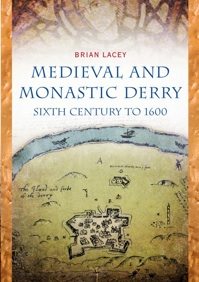
It should be said that one of the book’s great strengths is the in-depth treatment of source material and the collation of so many fascinating accounts of place-names, historic maps and descriptive textual sources: see for example the cover detail from the sketch-map illustrating Sir Henry Dowcra’s expedition of 1600 (National Library of Ireland: MS 2656, No 16) where the map is annotated ‘the island and forte of the derry‚’. Lacey describes how ‘in this book he has emphasized the changing fortunes of Derry-Londonderry by examining the contexts for secular politics through medieval times‚’. The early phase of the city is presented as a coherent balance of secular and ecclesiastical history throughout. This device works well as it creates the background context for the sense of continuity across the Middle Ages, and allows the reader to progress to the Early Modern period from 1600, when it is perceived that the cities‚’ Gaelic identity changed, with the arrival of the English plantation culture.
The ‘island‚’ of Derry’s monastic foundation is presented in this fascinating and informative, historical guide to the city. A companion to appreciate the history of this magnificent city, it is rich in archaeology and the many legends of early Ireland. This book is a must for anyone who is interested in and who is choosing to visit the city of Derry-Londonderry.
Lynda Mulvin is Senior Lecturer and Head of School at the School of Art History and Cultural Policy, UCD..
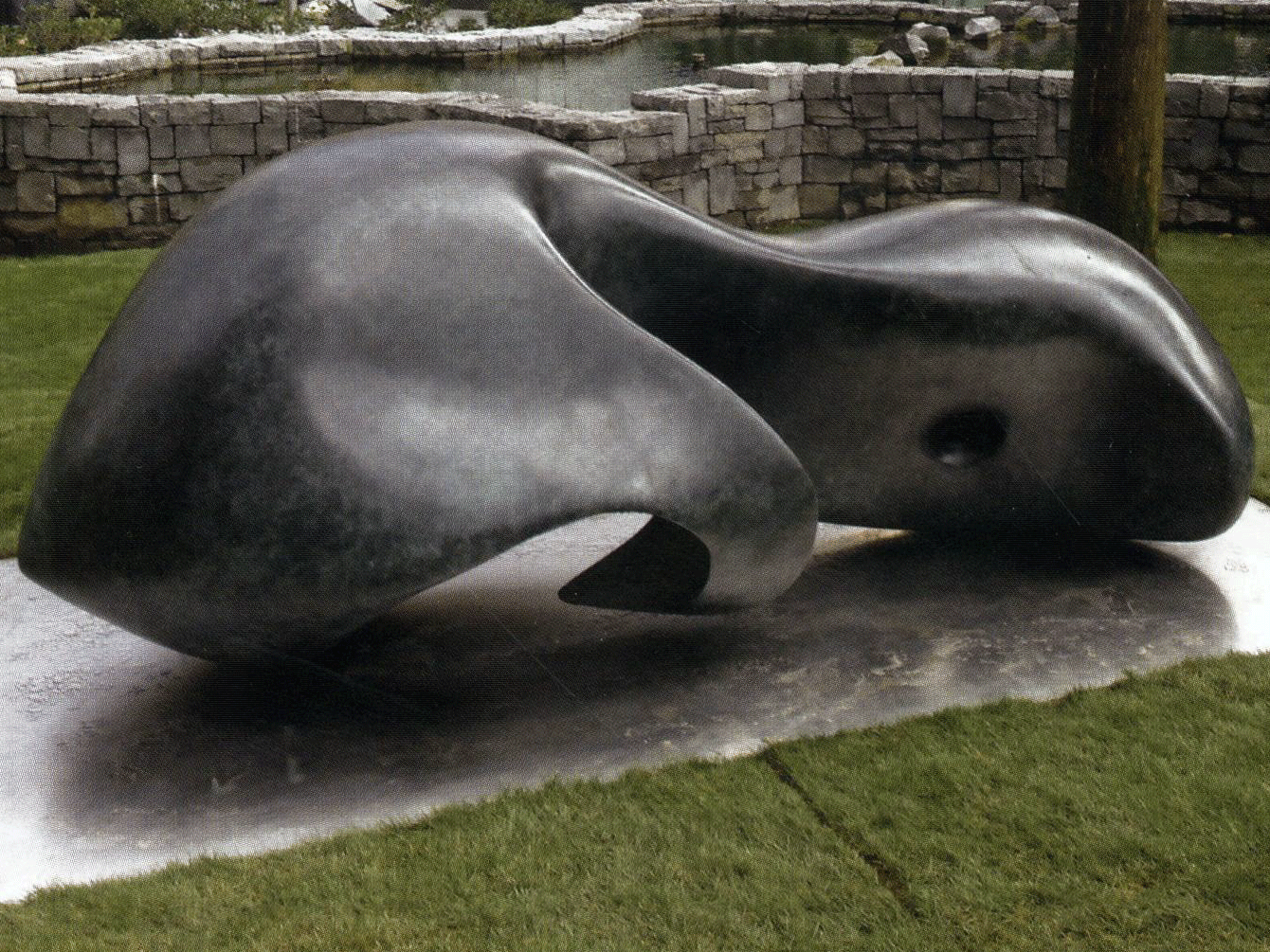
What is it about the work of the Irish sculptor Eilís O’Connell that has led to her having created, in this most difficult and masculine medium, over thirty permanent site-specific installations in Britain and Europe, including the sensual, orchid-like Unfurl (Fig 1), a bronze commissioned by Kensington Borough Council and the residents of Kensington Gate, to celebrate the Millennium?
O’Connell subtly combines a number of different elements that give her work both a sense of physical vitality and poetic metaphor. It is monumental yet intimate, atavistic yet contemporary. From discarded agricultural tools to birds’ nests and whale bones she appropriates the quotidian and the natural to create dynamic forms in stone, steel, resin, plaster and bronze. Like her poetic compatriot, Seamus Heaney, O’Connell looks to the archaeology and topography of her Irish homeland for inspiration but the ideas she finds there are filtered through a considered relationship to architecture and geometry. The work is never soft: emotion is always tempered by intellect and painstaking technique to combine something of the muscularity of Richard Serra with the female sensibility of Barbara Hepworth. Science and mathematics meet the natural world within her organic and biomorphic forms. Inside and outside coalesce. In the layered and slippery space of contemporary culture she has created objects that generate a unifying narrative and suggest a philosophy of interdependence rather than of confrontation, an openness and desire for contact and inclusivity, rather than a brittle postmodern autonomy, which unapologetically recalls the timeless resonances of Brancusi.
Anne Hodge and Peter Harbison examine the visual evidence of Daniel O’Connell’s unusual conditions of imprisonment in the Richmond Bridewell, Dublin
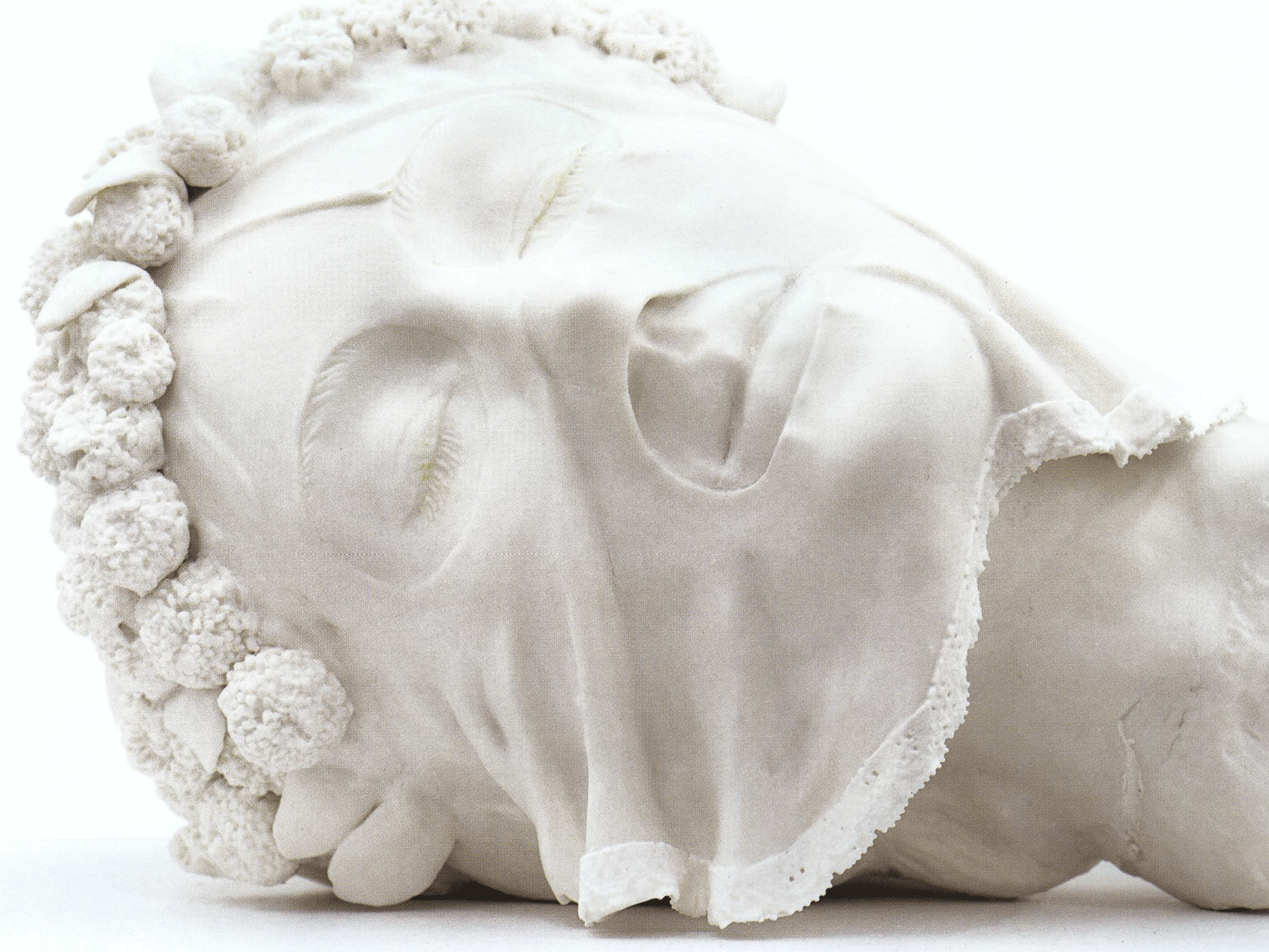
Ursula Burke, Emma Donaldson and Deirdre McKenna explore the mutable topic of time at the F E McWilliam Gallery, Banbridge. Claire Dalton looks at their responses