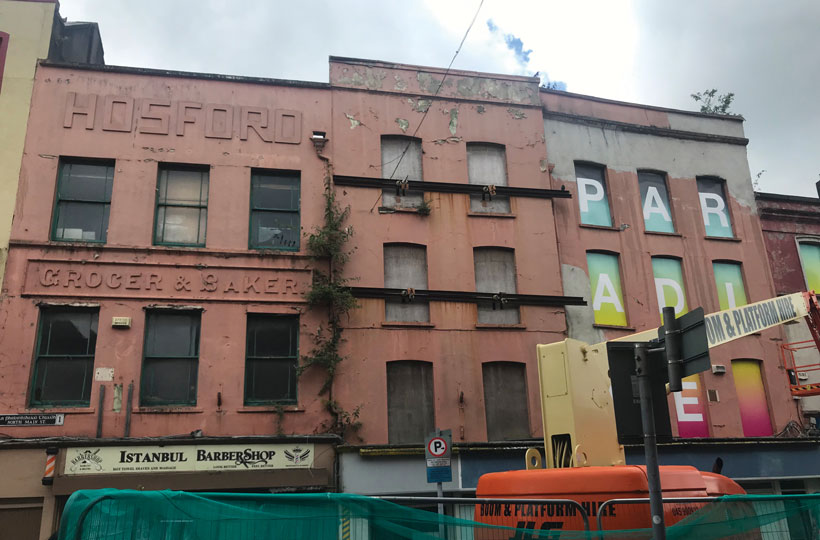
Years of ineffective heritage management, and neglect by owners, have left many historic buildings in Cork city in a poor state, with nearly one hundred listed as derelict. There have been instances of houses collapsing, and as recently as last June, the rear walls of several adjoining buildings in North Main Street gave way. The immediate response—that the buildings be demolished—has been averted, through it is likely that the only parts to be saved will be the facades. The danger of other structures collapsing is evident to anyone walking through the city today. A key part of Cork’s historic centre, North Main Street, with its narrow lanes and regular layout, dates back to the seventeenth century. While the fronts of the houses are mostly nineteenth century, behind the facades can be found a good deal of older stone and brickwork.
Sanctions should be matched by incentives, and fines balanced with encouragement, grants, and professional advice on restoration
The situation is similar in the county; a house in Bandon’s historic centre collapsed into the street recently, closing one of the town’s roads for several months. Discussing whether blame can be placed at the door of the local authority, whether the crisis is due to inefficient legislation, or stems from the inaction of house owners, is not helpful. This is a shared problem, one that can only be solved by people working together. It has been proposed that levies on derelict sites be increased and the powers of local authorities enhanced, but resorting to a regime of taxation and punishment is not the most effective way forward; sanctions should be matched by incentives, and fines balanced with encouragement, grants, and professional advice on restoration.
Twenty years ago, the Cork Vision Centre, in St Peter’s Church on North Main Street, was established by the then city architect to form a focal point for education on urban planning and the built environment. In the centre of that beautifully renovated church was a scale model of the entire city centre. However, the vision did not last, and for two decades St. Peter’s Church was used mainly for a variety of art and photography exhibitions. It is clearly time for local authorities to wake up and take action, before further buildings collapse
Peter Murray